

Blogs
2026/06/19
Let me begin with a small confession.
At Hitotsubashi ICS, the Capstone Project is the final required course for every MBA student, in both the one-year and two-year tracks. This year, the corporate track gave us four very different companies to choose from: INPEX, Japan's largest oil and gas exploration company; Bosch Japan in Yokohama, focused on mobility solutions; Yamaha Motor, known for its motorcycles, marine engines, and a famously wide range of machines; and Ginza Cozy Corner, a pastry chain located mainly in the Kanto area.
There were three tracks to choose from in total — a social impact project, an entrepreneurship project, and the corporate project. My original goal in coming to Japan for an MBA was to immerse myself more deeply in Japanese society. By that logic, the social impact track — volunteering in the regions still recovering from the 2011 Great East Japan Earthquake — would have taught me far more about real life in Japan than analyzing a pastry company's product line. You would be right to point that out. I thought so too.
But my Japanese simply is not good enough yet. And so, very honestly, I ended up in the corporate track partly by conviction and partly by linguistic surrender.
I am glad I did.
Why a Pastry Chain
For a foreigner who has not spent much of his career inside a traditional Japanese company — inside or outside Japan — Ginza Cozy Corner was a natural choice. It promised something I genuinely wanted: a glimpse into how an established, traditional Japanese company actually operates, from the inside rather than from across a glass display case.
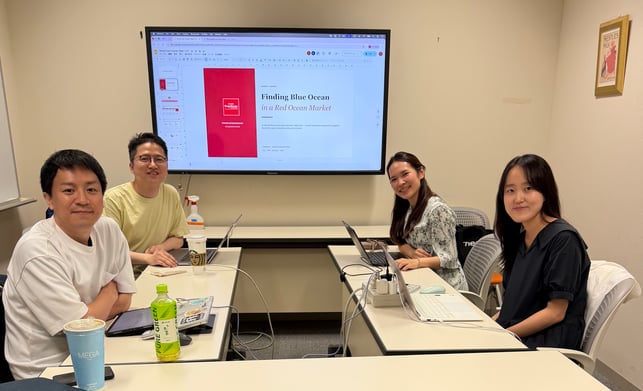
My team came together almost by gravity. Two of my teammates were from my very first study group when I arrived at Hitotsubashi ICS. Because Capstone would be my last in-class course, working again with the people I had started this journey with felt like a quiet bit of symmetry — the last chapter rhyming with the first. We teamed up because we are all easy to talk to and, frankly, very like-minded.
 The Journey, in Brief
Here is roughly how the month unfolded:
May 11 — First day. Capstone opened with our corporate-track instructors walking us through several strategic-thinking frameworks, and ended with us forming teams around our shared preferences.
May 12 — First team meeting. Two familiar face from old study group, plus a new fresh face, gathering for the final act.
May 13 — First instructor review. Our instructors were genuinely kind and gave us concrete, usable advice. More valuable still, they offered the critical and sometimes contrasting perspectives that a team of like-minded, agreeable people badly needs.
May 14 — Online meeting. My teammates live at varying distances from campus, so some meetings were simply more humane to hold online.
May 18 — Second instructor review. The instructors were not enchanted by our presentation style or our slide design. So we decided to tear it down and rebuild from scratch.
May 20 — Field trip to the Ginza flagship store.
.jpeg?width=824&height=618&name=image%202%20%20field%20trip%20(1).jpeg) Field trip to the Ginza flagship store
Field trip to the Ginza flagship store
May 21 — Third instructor review. We were nearly finished, and the feedback was overwhelmingly positive — so positive that it made us suspicious.
May 25 — Fourth review. Essentially a rehearsal, held in the very classroom where we would present, with no time left for any major overhaul.
May 28 — Final presentation to the Ginza Cozy Corner managers and our entire class.
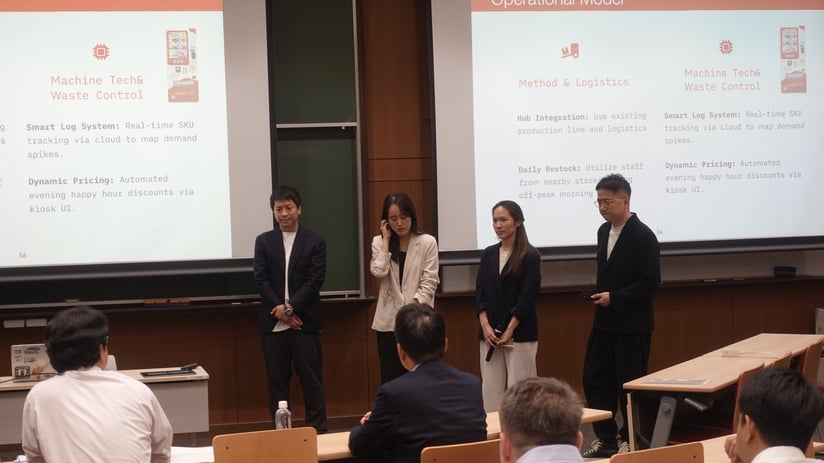 Final presentation
That is the clean version. The honest version has more rain in it.
The Café That Refused Us Three Times
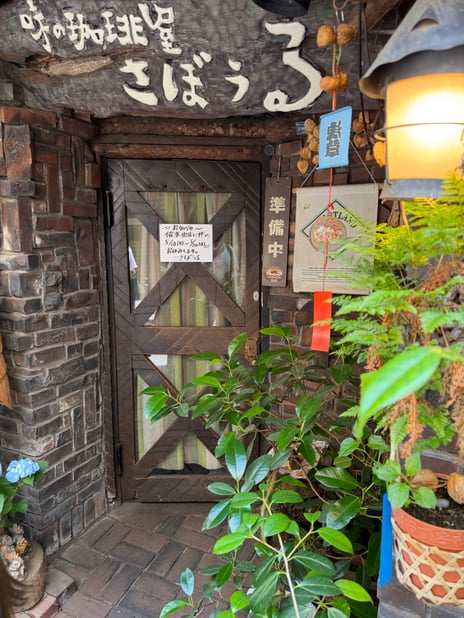
Somewhere in the middle of all this, we planned a team-building lunch. There was a small café about ten minutes' walk from campus. Initially we do not have a very high exception about the cafe. The café has good reviews on Google Maps, but frankly, it is very hard to find a truly bad café in this area.
On our first attempt, it was closed. On our second attempt, the café was open but the sky was not — the rain came down so hard that we postponed again. It took a third try, weeks later, before we finally sat down and ate.
By then, I can tell you with full confidence, the quality of the food no longer mattered.
What mattered was that we had decided to do a small, slightly silly thing, and we had refused to let a locked door and a rainstorm win. I have come to believe that when you set out to do something and you actually pull it off, the doing carries more weight than the thing itself. A lunch you fought for three times tastes better than any review on a map could promise.
A Store Seen from the Other Side of the Counter
Every Capstone company offers a field trip, and ours, conveniently, was in Ginza — a relatively short train ride away. Our hosts let us see the flagship store not as customers but as operators: the flow behind the counter, the choices that shape the display, the small operational decisions a customer never notices. Together with the other team assigned to Ginza Cozy Corner, we also had a frank Q&A session about the kinds of issues that are too sensitive to discuss over email.
There was one detail that captured my entire Hitotsubashi ICS experience in a single moment. The store owner could not speak English; I could not understand Japanese. And so my Japanese teammate, along with the members who understood the language, quietly became my translators — turning a conversation I could not have had on my own into one I will not forget.
The Suspicious Comfort of Good Feedback
By the third review, our instructors were very satisfied and generous with praise, and we were genuinely surprised by it. Surprised, because the workload we had put into this project was not heroic — it was honestly about the same as what we had poured into our other Hitotsubashi ICS course projects. Naturally, this set off a small spiral of overthinking: if it was this smooth for us, what on earth are the other teams doing? The fourth review, our mock run in the real classroom, gave us a few useful notes but, more importantly, made one thing clear — there was no time left to overhaul anything. From that point on, our job was simply to know our own analysis cold and to present it like we meant it.
On May 28, we did. And we walked out satisfied — not only because of the company's feedback, but because of everything we had spent to earn it.
A Blue Ocean, and the Names We Collect
So, what did I actually take away?
I will not pretend that a few weeks of analysis and a handful of exchanges with a company taught me the deep truth of how a Japanese business works, or that we handed Ginza Cozy Corner a flawless solution. We did not. But one thing about the company genuinely intrigued me: in a crowded, red-ocean confectionery market, it is searching for its own blue ocean. That search resonated more than I expected, because it mirrors a situation my own company faces back home in Shenzhen. Sometimes the most useful thing a Capstone gives you is not an answer for the client, but a sharper question for yourself.
And then there is the quieter, almost comic takeaway. For a foreigner, one real benefit of this project is simply “collecting Japanese company names." That sounds trivial until you live it. Now, every time I pass a Ginza Cozy Corner counter on the street or in a department store, a small bell rings: "I know this one. I did a Capstone on this company at Hitotsubashi ICS.” It is a small thing, but it also feels like a small step toward belonging — one more thread tying me to the country I came here to understand.
The Vulnerable Part
At Hitotsubashi ICS, I learned that a "good" reflection always contains a vulnerable moment. So here is mine.
Capstone is the last required course at Hitotsubashi ICS, which means it was my last course spent in the same room as so many classmates. That weight sat with me throughout the project. During one of our team meetings, I shared something more personal than the agenda called for. I still do not know whether it counts as over-sharing, but I meant every word of it: “for us, this project is not for the corporate, and not even for our audience — it is for us. It is a way to leave behind a good enough memory of our time at Hitotsubashi ICS.”
For the most part, I think I managed to make that memory for myself. I hope I helped make one for my teammates too.
The Race Is Long
I want to close with a line that has nothing to do with pastries or strategy frameworks, but that I would like to leave for any future or current Hitotsubashi ICS student who happens to find this:
"Sometimes you're ahead, sometimes you're behind. The race is long and, in the end, it's only with yourself."
— Mary Schmich
There is competition built into Capstone — two teams worked on the same company, in theory competed against each other, and there is no shortage of other races in and outside of school. I am not sure I am old enough or experienced enough to have earned this reflection, but I believe it anyway: being ahead or behind is a temporary condition. Business history is full of proof. What matters is that we keep showing genuine interest, enthusiasm, and curiosity toward the things, people, and life around us. When we are ahead, stay humble and keep learning. When we are behind, do not deflate — stay positive and keep learning. In any race, at the end of the day, the only conversation that truly counts is the one you have with yourself.
I wrote these words back at my company in Shenzhen, nearly half a month after the final presentation. The strong emotion of that last day has faded by now, as it always does. But I know I will remember every one of those teammates.
|
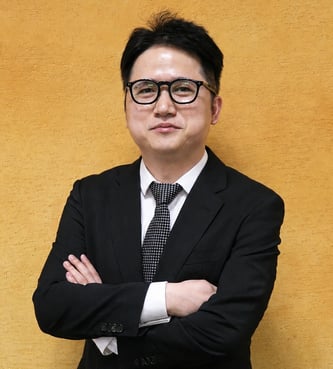
Tang Shuangyun (Tang), Class of 2025 Tang is a Chinese entrepreneur and 2-year MBA student at Hitotsubashi ICS (Class of 2027), with decades of experience in education and EdTech. He currently runs an EdTech company in Shenzhen. Before ICS, he earned a Master of Science from the University of Pennsylvania and a Master of Education from the University of Hong Kong. |