

Blogs
2026/06/19
By Alexander Calotes (Alex), Class of 2025
When I began my MBA journey at Hitotsubashi ICS, I expected to study strategy, finance, marketing, leadership, and operations through case studies, discussions, and frameworks. I knew the program would challenge me intellectually. What I did not fully understand was how different it would feel to take everything I had learned in the classroom and apply it to a real company, a real business problem, and a real client with real constraints.
The Corporate Project pillar became one of the most meaningful parts of my Hitotsubashi ICS experience because it shifted my MBA learning from theory to practice. Our Capstone Project with INPEX asked us to develop a business plan based on the company’s existing assets and strengths, exploring new approaches to energy provision by combining power, fuels, infrastructure, and energy flexibility options. At first, this sounded like a technical energy challenge. However, as our team progressed, I realized it was much more than that. It was a strategy challenge, a marketing challenge, a finance challenge, an organizational challenge, and ultimately, a leadership challenge.
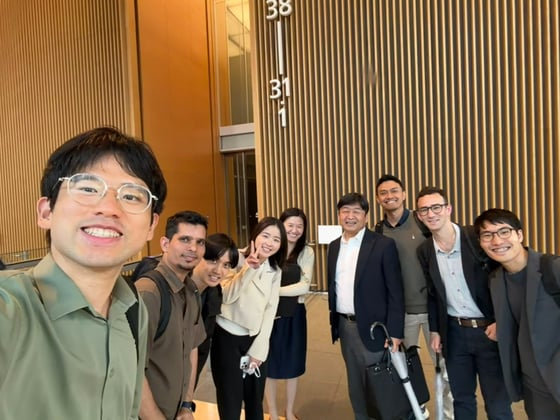

At the office of INPEX Corporation
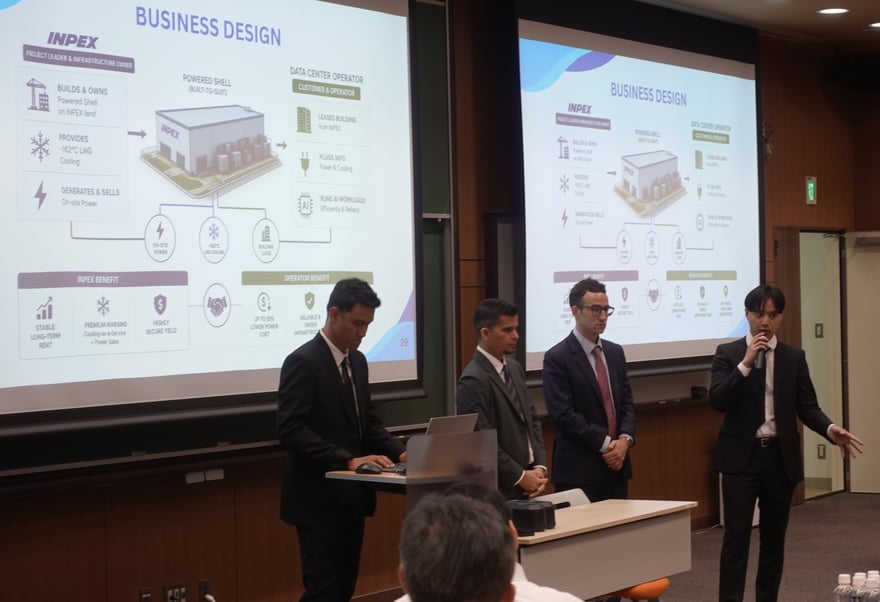
Our team focused on the potential use of LNG cold energy fromINPEX’s Naoetsu LNG Terminal to support data center cooling. As Japan advances toward decarbonization while also seeking energy security and resilience, data centers are becoming increasingly important infrastructure. They are essential for AI, cloud computing, digital transformation, and the broader technology ecosystem. At the same time, data centers require large amounts of reliable energy and cooling capacity. This created a compelling question for us: could INPEX transform an underutilized energy stream from LNG regasification into a valuable cooling solution for large-scale, high-performance data center operators?
As a Canadian engineer and MBA student, I was naturally drawn to the technical side of this problem. I wanted to understand the mechanics of LNG regasification, the amount of cold energy potentially available, the distance over which cooling could be transported, and whether a chilled water or water-glycol system could be feasible. My engineering background helped me feel comfortable with complexity, assumptions, calculations, and physical infrastructure. However, the capstone quickly taught me that a technically interesting idea is not the same thing as a strong business plan.
That was one of my first major lessons.
In the classroom, we often learn frameworks in a structured way. We study Porter’s Five Forces, the 3Cs and 4Ps of marketing, customer segmentation, value propositions, financial models, leadership concepts, and implementation plans. In the capstone, those frameworks were no longer separate tools. They had to work together. Our proposal could not simply answer, “Is cold energy technically possible?” It had to answer deeper questions: Who is the customer? What is the customer’s real job-to-be-done? Why is INPEX uniquely positioned to serve this need? What partnerships would be required? Could the solution scale beyond a pilot? Would the economics satisfy the client’s expectations?
This is where the Corporate Project became a true MBA experience. It forced me to integrate my learnings.
From Strategy, I learned to think about INPEX’s competitive advantage. INPEX is not simply an energy company with physical assets. It has infrastructure, technical capabilities, experience in LNG, relationships across the energy value chain, and a strategic interest in expanding beyond traditional oil and gas. This meant our proposal had to be grounded in what INPEX could do better than other players. We had to avoid recommending a generic solution that any utility, real estate developer, or data center operator could copy. Instead, we had to show how INPEX’s unique combination of assets could create a differentiated business opportunity.
From Marketing, I learned that our customer could not be “data centers” in general. That category was too broad. Different data center operators have different needs, priorities, cost structures, and decision criteria. A small or medium-sized data center might not justify the complexity of a cold-energy cooling solution. A large-scale or high-performance operator, especially one facing constraints around energy reliability, sustainability, and cooling demand, would be a stronger target. This changed the way I viewed the project - the solution was not about pushing a technology into the market. It was about identifying the customer segment whose pain points best matched INPEX’s capabilities.
This was a major shift in my thinking. Before Hitotsubashi ICS, I may have started with the asset: “INPEX has cold energy, so how can we use it?” Through the capstone, I learned to start with the customer: “Who has a painful enough problem that INPEX is uniquely positioned to solve?” That difference may sound simple, but it completely changes the quality and perspective of a business plan.
From Corporate Finance and Accounting, I learned that a strategy eventually materializes into numbers. We had to translate our idea into value drivers, cost drivers, assumptions, risks, and returns. It was not enough to say that the concept sounded promising. We had to examine whether the project could make economic sense. What would the customer save? What could INPEX charge? What investment would be required? What utilization level would be necessary? What hurdle rate was to be beaten? What risks could affect the economics? Finance helped convert our story into a decision-making tool.
One of the most valuable parts of the capstone was learning how to create alignment. We had to align with the client’s expectations, our professors’ guidance, our teammates’ perspectives, and the realities of the market. In a classroom case discussion, the facts are usually prepared for us. In the capstone, the facts were incomplete, uncertain, and sometimes contradictory. We had to make assumptions, test them, revise them, and communicate them clearly. This required not only analytical discipline but also humility.
The most difficult moment came near the end of the project. After putting significant effort into our proposal, we learned that INPEX had already considered a similar direction in the past and that it had faced internal challenges. My immediate reaction was disappointment. I felt that perhaps we had failed because our idea was not as new or as persuasive as we had hoped. However, after reflecting on the experience, I came to see that this moment was one of the most important lessons of the entire capstone.
In the real world, a business idea can be logical, creative, and well-structured, but still face organizational, strategic, or timing barriers. Innovation is not only about finding an attractive concept. It is about understanding why a concept has not already scaled, what barriers exist, and what would need to change for the idea to become actionable. This was a humbling realization. It taught me to separate the mission from the method. The mission was to help INPEX think about how to leverage its assets for the energy transition. The method we proposed was LNG cold energy for data center cooling. Even if the method faced challenges, the learning process remained valuable because it taught us how to think, analyze, communicate, and adapt.
This experience also deepened my self-awareness as a leader. I learned that I tend to feel personally attached to ideas after investing significant effort in them. That can be a strength because it reflects commitment and ownership. However, it can also become a weakness if I confuse effort with success. The capstone taught me that strong leadership requires the ability to care deeply about the work while remaining open to reality. A leader must be passionate, but not stubborn. Confident, but not defensive. Analytical, but not detached. Creative, but not unrealistic.
The capstone also changed how I understand the purpose of an MBA. Before this experience, it was easy to think of the MBA as a collection of courses: strategy, finance, marketing, leadership, operations, and so on. After the capstone, I see the MBA more as an integrated way of thinking. A real business problem does not arrive neatly labeled as a “marketing problem” or a “finance problem.” It arrives as a messy situation with multiple stakeholders, incomplete data, competing priorities, and uncertain outcomes. The value of the MBA is learning how to bring structure to that ambiguity.
This is one of the things I appreciate most about Hitotsubashi ICS. The program does not only ask students to learn concepts. It asks us to test ourselves. Through the Corporate Project, we were placed in a situation where our ideas had to meet the expectations of an actual company. That made the learning more intense and more memorable. It also made the learning more personal. I was not just studying leadership. I was experiencing moments that tested my leadership. I was not just studying marketing. I was trying to identify a real customer with a real need. I was not just studying finance. I was trying to understand whether a proposal could meet real investment logic.
Another important takeaway was the value of cross-disciplinary teamwork. Energy transition challenges cannot be solved through one perspective alone. They require technical understanding, commercial logic, policy awareness, financial discipline, customer insight, and organizational execution. Our team had to combine these different perspectives. Sometimes that made the process difficult, but it also made it richer. I learned that my engineering background is valuable, but it becomes much more powerful when combined with the business tools I have developed at Hitotsubashi ICS and the diverse perspectives of my classmates.
Looking back, I am grateful that the project was difficult. If the answer had been obvious, the learning would have been less. The ambiguity forced us to think harder. The constraints forced us to prioritize. The feedback forced us to reflect. The disappointment forced me to grow.
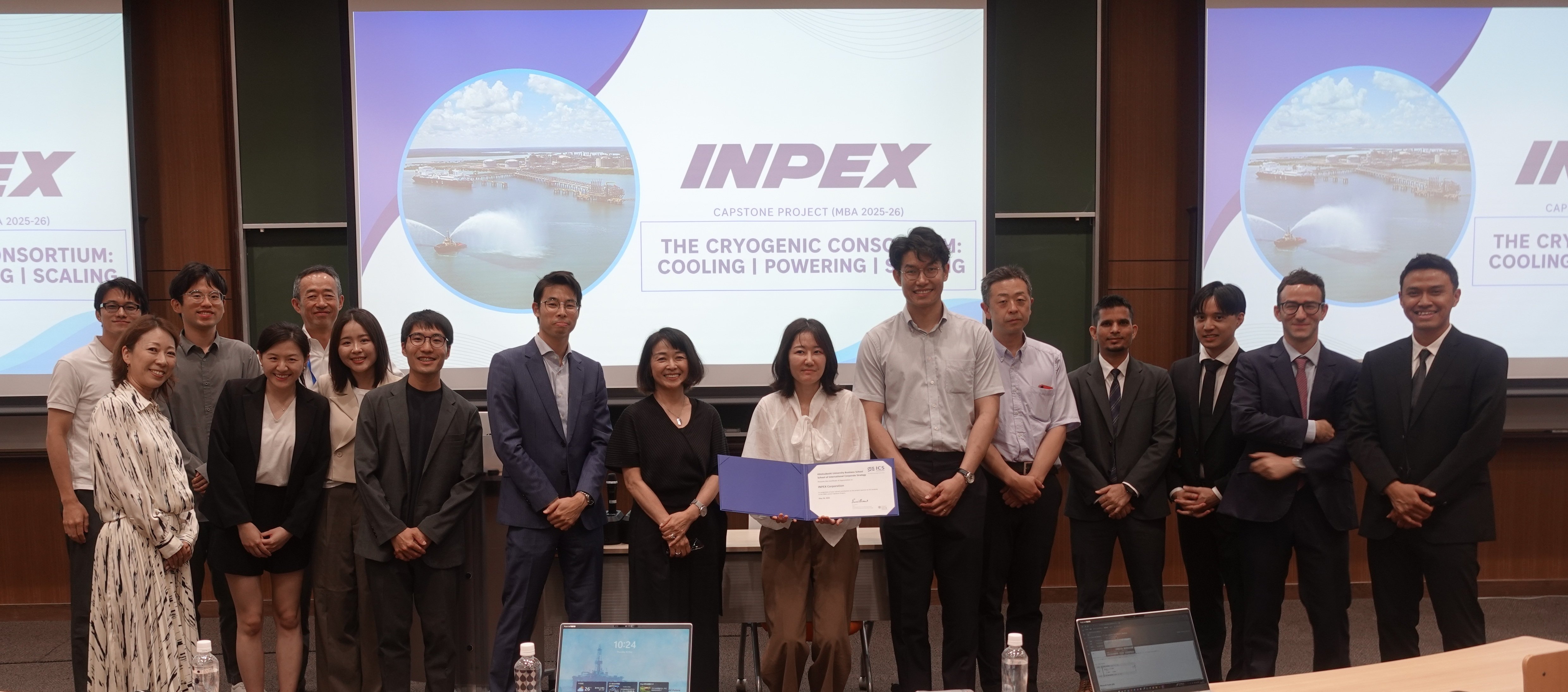
The INPEX Capstone Project shaped my MBA journey by showing me what it means to become a business leader in practice. It reminded me that leadership is not proven only when things go smoothly. It is revealed when plans change, when assumptions are challenged, and when we must decide how to respond. For me, the project reinforced the kind of leader I aspire to become: someone who can connect technical and business perspectives, unite people around a shared objective, remain humble in the face of reality, and continue moving forward with purpose.
In the end, our project was about cold energy, but my biggest learning was about human energy: the energy of a team working through uncertainty, the energy of ideas being challenged and improved, and the energy of personal growth that comes from doing difficult work. That is what made the Corporate Project one of the most valuable experiences of my MBA journey at Hitotsubashi ICS.
|
Alexander Calotes (Alex), Class of 2025 Alex is a Canadian engineer and 2-year MBA student at Hitotsubashi ICS (Class of 2025), with nine years of experience as a Project Manager with Canada’s largest construction management companies. Through his work on major commercial, industrial, and urban redevelopment projects, he has developed expertise in project delivery, stakeholder coordination, infrastructure management, and cross-functional problem solving. At Hitotsubashi ICS, Alex’s academic and professional interests include real estate development, infrastructure strategy, sustainable finance, and international business. He is particularly interested in bridging business between Japan and North America by combining his engineering and project management background with the strategic, financial, and leadership skills developed through the MBA. Looking ahead, he hopes to contribute to real estate and infrastructure development that connects global perspectives, supports sustainable growth, and strengthens collaboration between Japanese and North American organizations. |